Cosmetic
PRP and PRF for Periocular Rejuvenation
פלזמה עשירה בטסיות וספירין משתמשים בגורמי גדילה מהדם שלך כדי לשפר את איכות העור, להפחית עיגולים כהים ולשפר טיפולים סביב העיניים.
Platelet-rich plasma (PRP) and platelet-rich fibrin (PRF) are autologous biologic therapies that harness concentrated growth factors from a patient’s own blood to stimulate tissue repair, improve skin quality, and rejuvenate the delicate periocular region. Originally developed for orthopedic and dental applications, these treatments have become increasingly popular for cosmetic facial rejuvenation — particularly for under-eye dark circles, fine lines, and crepey skin where traditional fillers may be poorly suited. For oculoplastic surgeons, PRP and PRF represent a valuable addition to the periocular toolkit, but one that demands the same anatomical respect and clinical judgment as any injectable in this unforgiving region.
Unlike synthetic fillers or neuromodulators, PRP and PRF do not add volume or paralyze muscle. Instead, they recruit the body’s own regenerative machinery — signaling fibroblasts to produce new collagen, encouraging angiogenesis, and modulating inflammation. The result is a gradual improvement in skin quality, tone, and texture rather than a dramatic structural change. Understanding what these therapies can and cannot deliver is essential to setting realistic expectations and choosing the right treatment.
PRP vs. PRF: What’s the Difference?
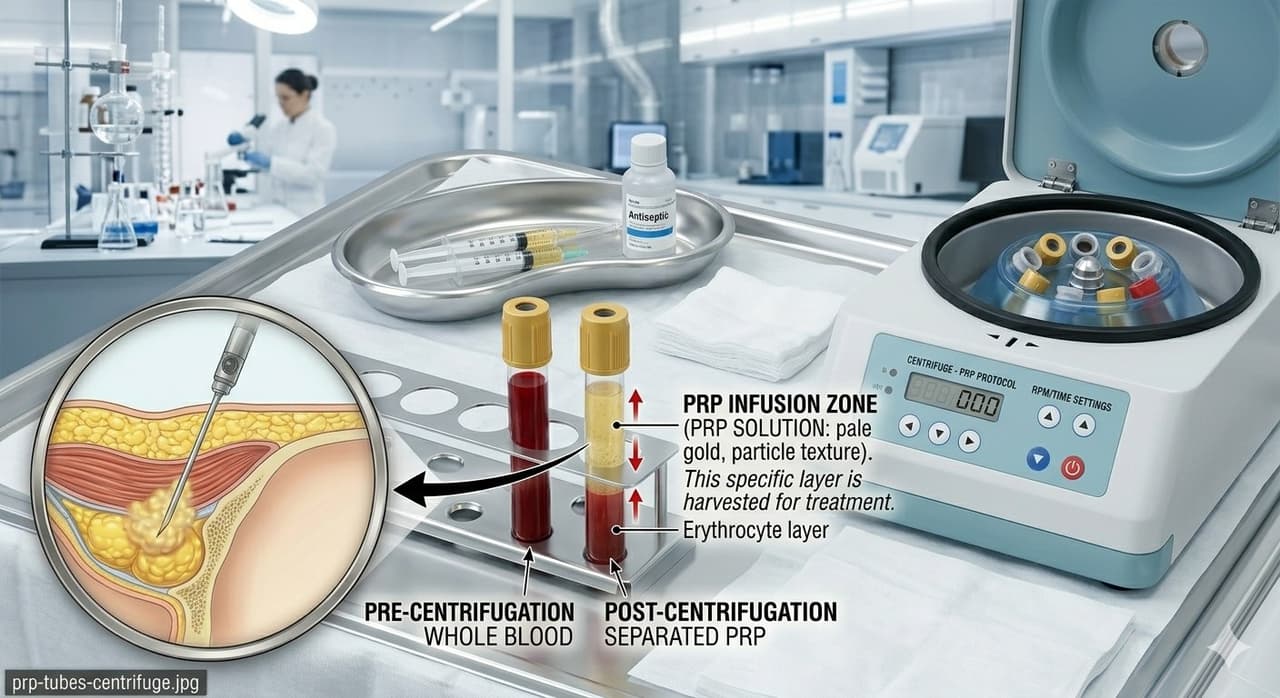
Although the names sound similar, PRP and PRF are produced differently and behave differently in tissue. Both begin with a small venous blood draw — typically 10 to 30 mL — that is processed in a centrifuge to separate platelets and plasma from red blood cells. The key differences lie in how that separation is performed.
PRP (platelet-rich plasma) is considered the first generation of platelet concentrates. Blood is collected into tubes containing an anticoagulant (typically sodium citrate) and spun at relatively high speeds. The resulting product is a liquid plasma fraction enriched with platelets, usually 3 to 5 times baseline concentration. Because PRP remains liquid, it injects smoothly and can be activated with calcium chloride to trigger immediate growth factor release.
PRF (platelet-rich fibrin) is the second-generation evolution. PRF uses no anticoagulant and a slower, gentler centrifugation. Without anticoagulant, the natural clotting cascade begins, producing a fibrin matrix that traps platelets, leukocytes, and growth factors. The resulting product is a thicker, gel-like substance that releases growth factors slowly over 7 to 14 days, compared with the rapid burst from PRP. Newer protocols also produce liquid PRF (sometimes called i-PRF or injectable PRF), which combines easier injection with slower growth factor release.
PRP
- Uses anticoagulant (citrate)
- Faster, higher-speed spin
- Liquid consistency
- Rapid growth factor release
- Lower fibrin and leukocyte content
- Easier to inject through fine needles
PRF
- No anticoagulant
- Slower, gentler spin
- Fibrin matrix (gel or liquid)
- Sustained release over 1–2 weeks
- Higher leukocyte and platelet content
- May offer scaffolding effect
Most oculoplastic surgeons now prefer PRF or liquid PRF for periocular work because the sustained growth factor release more closely matches the slow timeline of collagen remodeling, and the absence of additives means a truly autologous product.
How Growth Factors Work
Platelets are best known for their role in clotting, but they also carry hundreds of bioactive proteins inside their alpha granules. When platelets are concentrated and delivered to tissue, they release a cocktail of growth factors that orchestrate wound healing and tissue regeneration. The most clinically relevant include:
- PDGF (platelet-derived growth factor) — stimulates fibroblast proliferation and collagen synthesis
- TGF-β (transforming growth factor beta) — drives extracellular matrix production and fibroblast differentiation
- VEGF (vascular endothelial growth factor) — promotes angiogenesis and improves microvascular health
- EGF (epidermal growth factor) — supports epidermal cell turnover and barrier function
- IGF-1 (insulin-like growth factor) — modulates cellular proliferation and survival
- FGF (fibroblast growth factor) — enhances tissue remodeling and vascular development
In the periocular skin, this growth factor signaling translates to thicker dermis, improved elasticity, better microcirculation, and a modest reduction in pigmentation. The effect is gradual — collagen remodeling unfolds over 8 to 12 weeks — and cumulative with repeated treatments. Unlike a filler that disappears when hyaluronidase is injected, PRP and PRF effects are biologically integrated and persist for many months.
PRP and PRF are biologic regenerative therapies, not volumizing fillers. For true hollowing in the tear trough, hyaluronic acid fillers or facial fat grafting remain more appropriate.
Periocular Applications
The periocular region presents unique challenges for cosmetic treatment. Skin here is thinner than anywhere else on the body, lies directly over delicate orbital structures, and shows aging early. Hyaluronic acid fillers can correct volume loss but sometimes produce a bluish discoloration (the Tyndall effect) or chronic swelling. Lasers improve texture but require downtime. PRP and PRF fill an intermediate niche — gentle, regenerative, and well-suited to the periocular environment.
Under-Eye Dark Circles
Dark circles have multiple causes: thin skin revealing underlying vasculature, pigmentation, shadowing from volume loss, and venous congestion. PRP and PRF are particularly well-suited to the vascular component — growth factor stimulation thickens the overlying dermis, improves microcirculation, and reduces the visibility of underlying veins. Some pigmentary improvement may also occur through modulation of melanocyte activity, though this is less predictable.
Skin Quality and Fine Lines
Crepey, thin periocular skin responds well to PRP and PRF because growth factor stimulation rebuilds dermal collagen. Patients often report that makeup applies more smoothly and that their skin looks “rested” rather than dramatically different. This is a quality-of-skin improvement, not a wrinkle eraser.
Adjunct to Other Treatments
One of the most powerful applications is using PRP or PRF to enhance other procedures — mixed with fat during facial fat grafting to potentially improve graft survival, applied topically after RF microneedling to accelerate healing, or following laser resurfacing to reduce downtime.
Treatment Protocol
A typical periocular PRP or PRF session takes about an hour from arrival to discharge. The process is straightforward but every step matters for the quality of the final product.
- Consultation and consent — review of goals, medical history (anticoagulants, bleeding disorders, active infection), photography, and discussion of realistic outcomes.
- Blood draw — typically 10 to 30 mL of venous blood, collected into specialized tubes (with citrate for PRP, plain glass or silica for PRF).
- Centrifugation — spin protocols vary by system, but generally 5 to 15 minutes. Slower spins for PRF preserve the fibrin matrix.
- Topical anesthesia — numbing cream applied for 15 to 20 minutes for patient comfort.
- Injection or microneedling — the product is either injected as a series of small superficial deposits using a fine 30 or 32 gauge needle, or applied topically immediately following microneedling so the channels carry growth factors into the dermis.
- Post-treatment — cold compresses, sun protection, and gentle skincare. Mild swelling and bruising are expected.
Injection technique in the periocular region must be exquisitely superficial — intradermal or immediately subdermal — to avoid the rich vascular network around the orbit. Deep injection serves no purpose for skin rejuvenation and dramatically raises the risk of bruising or, in rare cases, vascular complications.
Important: Although PRP and PRF are autologous, periocular injections can still cause bruising, swelling, lumps, infection, and (rarely) vascular occlusion. The supratrochlear and supraorbital vessels lie within injection territory and demand respect.
Evidence and Limitations
Honesty about the evidence base is essential. Compared with the decades of randomized trial data supporting blepharoplasty or even hyaluronic acid fillers, the literature on periocular PRP and PRF is younger, smaller, and more heterogeneous. Most published studies are case series or small comparative trials, and outcome measures vary widely.
That said, the trajectory of the evidence is encouraging. Multiple studies have demonstrated measurable improvements in periorbital dark circles, skin elasticity, and patient satisfaction following PRP treatment. Histologic studies show increased collagen and elastin in treated skin. The biologic plausibility — growth factor signaling driving fibroblast activity — is well established.
What PRP and PRF cannot do:
- Replace volume loss in the tear trough or midface
- Remove herniated orbital fat (“bags”)
- Lift redundant or lax eyelid skin
- Erase deep static wrinkles
- Produce immediate, dramatic results
Patients hoping for a surgical-grade result from a biologic injection will be disappointed. The honest conversation is about gradual, modest improvement in skin quality — valuable, but bounded.
Number of Sessions
PRP and PRF results are cumulative. A single session can produce visible improvement, but most patients achieve their best outcome with a series of treatments spaced 4 to 6 weeks apart.
| Goal | Typical Series | Maintenance |
|---|---|---|
| Under-eye dark circles | 3–4 sessions, 4–6 weeks apart | Every 6–12 months |
| Skin quality / fine lines | 3 sessions, 6 weeks apart | Yearly |
| Adjunct to microneedling | 3–4 combined sessions | Yearly |
| Adjunct to fat grafting | Single intraoperative use | N/A |
Results typically become visible 4 to 8 weeks after the first session and continue to improve as the series progresses. Maintenance treatments help preserve gains, as ongoing aging, sun exposure, and gravity continue their work regardless.
Combination Treatments
Some of the most effective uses of PRP and PRF are in combination with other periocular procedures, where their regenerative signaling amplifies the results of the primary treatment.
PRP + RF Microneedling
This is perhaps the most popular combination. RF microneedling creates controlled microchannels and delivers thermal energy to stimulate collagen. Topical PRP applied during the procedure soaks into those channels, delivering growth factors directly to the dermis. Patients often report faster recovery and enhanced skin quality compared with microneedling alone.
PRP + Fat Grafting
When mixed with harvested fat before injection, PRP may improve adipocyte survival and integration. While not all studies show benefit, the rationale — growth factor support during the vulnerable early days after grafting — is sound, and many surgeons routinely incorporate PRP into their facial fat grafting protocols.
PRP After Laser Resurfacing
Following ablative or fractional laser treatment, topical PRP can accelerate re-epithelialization and reduce post-procedure redness. This is especially valuable around the eyes where downtime visibility is a concern.
PRP and Neuromodulators
PRP and botulinum toxin work on different targets — skin quality versus muscle activity — and combine well in a comprehensive skin rejuvenation plan.
Thoughtful combination — not piling on every modality — produces the best periocular outcomes. A surgical consultation can help map a sequenced plan tailored to your anatomy and goals.
Why an Oculoplastic Surgeon?
PRP and PRF are increasingly offered in medspas, dermatology offices, and even by non-physician injectors. The procedure itself — draw blood, spin, inject — appears simple. But the periocular region is one of the most anatomically complex areas of the face, and complications here have unique consequences.
An ASOPRS fellowship-trained oculoplastic surgeon brings a perspective that other providers cannot match:
- Intimate anatomical knowledge of the eyelid and orbit, including the precise course of the supratrochlear, supraorbital, infraorbital, and angular vessels.
- Recognition of structural problems that PRP cannot fix — ptosis, eyelid laxity, festoons, herniated fat — and the ability to offer the right treatment instead.
- Surgical management if a complication arises, from infection to the rare but devastating vascular event.
- Honest counseling when a patient’s goals are better served by surgery, fillers, or a different modality than by repeated biologic injections.
The most common mistake in periocular cosmetic medicine is treating an anatomical problem with the wrong tool. A patient with significant lower eyelid fat herniation will not be helped by PRP, no matter how many sessions are performed. A patient with true brow ptosis needs a brow lift, not skin treatments. Knowing when to say “PRP isn’t the right answer for you” is as important as knowing how to perform the injection.
PRP and PRF are valuable, evidence-supported additions to the cosmetic periocular toolkit when used in the right patients for the right indications. They will not replace surgery, but they offer a regenerative option for skin quality and dark circles that fits comfortably alongside other modalities. If you are considering PRP or PRF for your eyes, work with a surgeon who understands the full spectrum of periocular care. Find an ASOPRS-trained oculoplastic surgeon in your area to discuss whether PRP, PRF, or another approach best matches your anatomy and goals.
שאלות נפוצות
- Who is a good candidate for PRP and PRF periocular rejuvenation?
- Ideal candidates are patients with mild to moderate dark circles, under-eye hollowing, fine lines, or loss of skin elasticity around the eyes who prefer natural, minimally invasive options. You should be in good overall health with realistic expectations about results, though patients of various ages and skin types can benefit from this treatment. Those with active infections, severe bleeding disorders, or certain medical conditions may not be suitable candidates and should discuss their medical history with a specialist during consultation.
- What happens during a PRP/PRF consultation for eye area treatment?
- Your oculoplastic surgeon will examine the skin around your eyes, assess your specific concerns like dark circles or hollowing, and explain how PRP or PRF can address these issues. The consultation includes a discussion of your medical history, current medications, and realistic expectations for results and timeline. Your surgeon will also determine the best injection sites and may take photos for before-and-after comparison.
- What is the difference between PRP and PRF for periocular treatment?
- Both PRP (platelet-rich plasma) and PRF (platelet-rich fibrin) are derived from your own blood and contain growth factors that stimulate collagen and improve skin quality. The main difference is that PRF is processed without anticoagulants, creating a fibrin matrix that releases growth factors more slowly and may provide longer-lasting results. Your surgeon can recommend which option is best suited for your specific concerns and desired outcomes.
- What should I expect during recovery after PRP or PRF injections around my eyes?
- Recovery is typically minimal since this is a non-surgical procedure—most patients experience only mild swelling, redness, or bruising at injection sites that usually resolves within 24-48 hours. You can typically return to normal activities immediately, though avoiding intense exercise and sun exposure for a few days is recommended. Most surgeons advise avoiding rubbing the eyes and sleeping on your back for the first night to minimize swelling.
- How long does it take to see results from PRP or PRF periocular rejuvenation?
- Initial improvements in skin texture and hydration may be visible within 1-2 weeks, as the growth factors begin stimulating collagen production. More significant results in dark circles reduction and skin quality improvement typically develop over 4-8 weeks as collagen remodeling progresses. Results continue to improve gradually and can last 12-18 months or longer, with maintenance treatments recommended to sustain optimal outcomes.
- Are there any risks or complications associated with PRP/PRF for the delicate eye area?
- Serious complications are rare since this uses your own blood products, but temporary side effects may include mild swelling, bruising, redness, or tenderness at injection sites. There is a minimal risk of infection, allergic reaction, or asymmetrical results if injected improperly, which is why choosing a fellowship-trained oculoplastic surgeon is important. The delicate periocular skin requires precise technique and detailed anatomical knowledge to ensure safety and optimal aesthetic outcomes.
- How much do PRP and PRF treatments typically cost for eye rejuvenation?
- Costs vary based on the extent of treatment, number of injection sites, and whether PRP or PRF is used, as well as geographic location and surgeon expertise. Since these are cosmetic procedures, they are typically not covered by insurance, and patients should discuss pricing during their consultation. Many surgeons offer package pricing for multiple treatment sessions, as some patients benefit from a series of injections spaced several weeks apart for optimal results.